

Henri Gaudier-Brzeska’s Putney connection
Henri Gaudier-Brzeska’s Putney connection
Hugh Thompson explore the artist’s life in London.
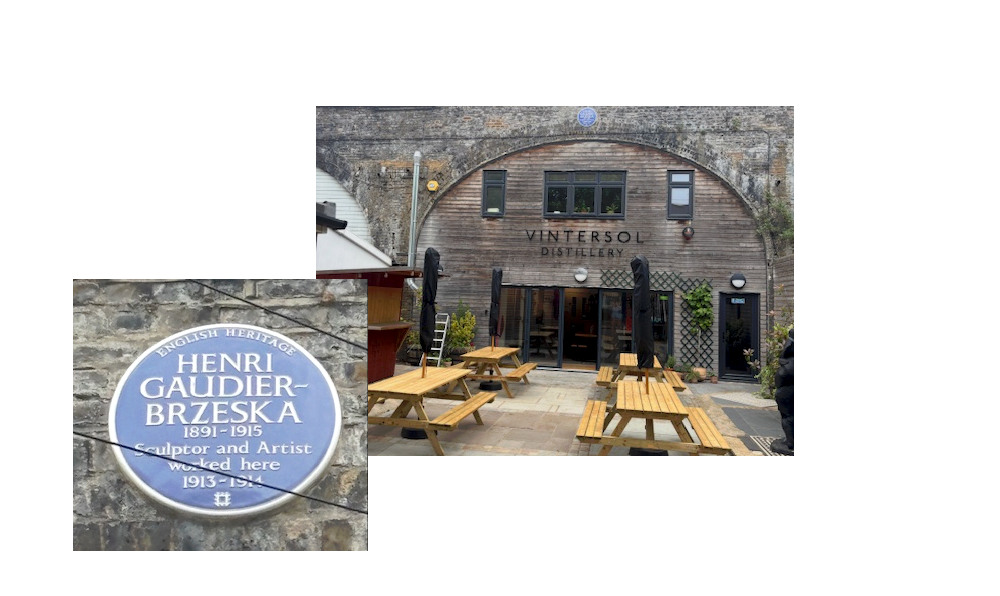
One of the great sights of this summer is the giant Henry Moore sculptures set in the green and pleasant fields of Kew Gardens. Few would make a connection with these heroic eternal pieces and a nondescript back street, Winthorpe Road by the railway arches in East Putney. But connection there is, English Heritage have recognised that the sculptor Henri Gaudier-Brzeska (1891-1915) had a studio there for 18 months of his tragically short but extremely eventful life. Many credit him with the style and abstract fashion which allowed such well known greats as Henry Moore, Elizabeth Fink and Barbara Hepworth to achieve the profile that abstract sculpture enjoys today. Moore famously said that Gaudier had inspired him by achieving beauty “along other paths than those of traditional sculpture”. Tate Britain has just ended a two year display of the Frenchman’s art. Savage Messiah is the title of his biography by H.S. Ede.
It’s not an easy story. Henri Gaudier, the Polish bit came later, was born and raised near Orléans. His father, a successful carpenter, had every reason to have high and conventional hopes for his son. Always interested in art and drawing, aged 15, Henri won a scholarship to study business in London, another scholarship soon followed and he went to University College, Bristol. In 1908 his interest in art and its relationship with nature is growing but he gets an internship with a coal merchant in Cardiff, from there the restless Bohemian moves to Nuremberg, Germany – all the time sketching while working as a translator or doing odd jobs. Paris calls as it does to many artists. There he decides to devote himself totally to art. This involves days spent drawing in the Bibliothèque Sainte-Geneviève. And it is there early in 1910 that the eighteen year old meets the 38 year old Polish writer Sophie Brzeska. And the story really begins.
Her story is sad. She spent most of her life looking for love, an occupation and a vocation. In her life she remained an unpublished writer, she travelled over Europe and America working as a nursemaid and governess, having engagements and affairs which left her very much alone and depressed. She would die in a psychiatric hospital. But in 1910 still a hopeful writer she was scribbling away in the Bibliothèque Sainte-Geneviève when a young man insists on sitting next to her. She pretends not to notice. They start to talk, and talk and talk. They are souls meant for each other. Close but never totally physical. He takes her home to meet the parents, they are not impressed and desperately suspicious, others in the village also ask questions about their relationship. Henri is called up at a time when France is fighting colonial wars in North Africa.
The story moves to London. In order to cohabit as brother and sister without questions they both become Gaudier-Brzeska. At first it is difficult, Henri does not find work and sells portraits in pubs for a penny a go, Sophie even begs. But after a couple of months, Henri gets work in the City with a Norwegian firm translating and Sophie gets a job as a governess in Felixstowe. Long lengthy letters keep them close and here we see the extraordinary depth of Henri’s knowledge, thought and development as an artist. He is moving more and more towards sculpture. In Paris he was influenced by Rodin, in London Jacob Epstein is his star but more and more his travels to the V&A and the British Museum lead him away from the straight Greek style and more towards African and Oceanic abstraction.
Henri persuades Sophie to come back to London and they live a life of extreme poverty in a sequence of rooms in Kensington and Chelsea. But all the time he is moving on artistically.
After a year of ducking and diving, scraping and making do, in January 1912 Henri approaches Haldane Macfall of the influential art magazine English Review. One way or another this opens the door. His drawings are accepted, he makes contacts and suddenly with his ideas, personality and talent he becomes something of a star. Other magazines show interests not only in his drawings but his ideas. His contribution to Blast, the Vorticist magazine, is part of his legacy.
There is of course a problem, Sophie. Time and again promising entrees come to nothing as Sophie’s behaviour is often obnoxious, aggressive or extremely emotional. And Henri is fanatically loyal. But commissions do come. Contacts are made. Notably Ezra Pound, Wyndham Lewis, Frank Harris and Katherine Mansfield. One commission of a statue of the ballerina Maria Carmi which Lord Northcliffe said he would buy for £200 eventually came to a rejection and £5. Henri earned £7 a month in the City.
Henri was so poor he could not afford to pay for materials, at one point he even stole from a graveyard and many of his sculptures (of which there are around 100) are small. He becomes one of the founding members of the London Group, which was opposed to the formalism of the RA and which included Sickert and Epstein.
Which brings us onto his Putney studio. One of his subjects was the Australian artist Horace Brodzky, who wrote, “His studio was a railway arch over which the electric trains rumbled all day. He occupied only half of the arch, which had been divided lengthways by a wooden partition. It was a good workman-like place with a concrete floor, well lit by windows at each of its quadrant-shaped ends. The other side of the partition was occupied by an Italian sculptor, who had been a neighbour of Brzeska’s at Fulham and had asked him to share the cost of converting this barrel-roofed “studio” at Putney, to which Brzeska was agreeable as there was a saving of rent… In wet and cold weather however, the new workshop was a miserable and chilly place, for it was difficult to heat. ‘The new workshop contained nothing designed for comfort. Benches, a portable furnace for tempering his chisels, a couple of decrepit chairs and a small stove were all its furniture. It even looked barer than his Fulham studio, for there seemed to be a chair or two less.’
In 1914 when Germany invaded France Henri volunteered. He was killed a year later.
For the last five years, his studio has been home to the Scandinavian aquavit Vintersol Distillery. Manager Sasha Bladt-Cohen says, “We do get a steady stream of visitors who take a picture of the plaque, some come in and have a drink and look at the artist’s drawings we have.”