


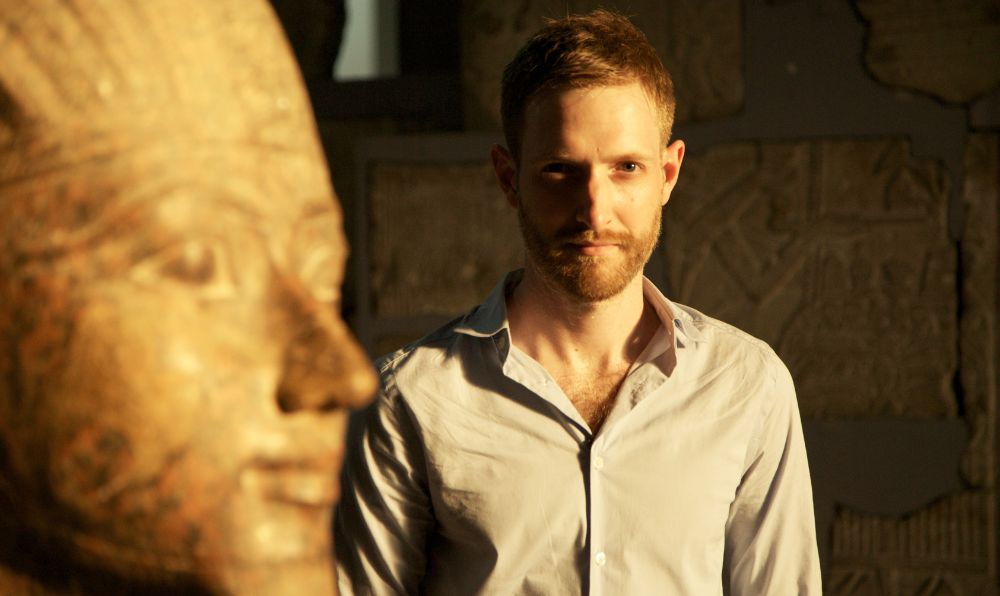
Interview: Egyptologist Chris Naunton
Interview: Egyptologist Chris Naunton
South West London Egyptologist Chris Naunton tells us about his new project Cleopatra: The Immersive Experience, the incredible local connections to Ancient Egypt, and holding Tutankhamun’s dagger …
By Ben Berman
Chris Naunton is known for making ancient Egypt accessible through documentaries for the BBC, Channel 4 and National Geographic, and his bestselling books including Searching for the Lost Tombs of Egypt. His latest project is Cleopatra: The Immersive Experience, which combines immersive VR, cutting-edge tech and real artefacts. Chris opens up about his experiences studying Ancient Egypt, his go-to historical spots in SW London, and the origins of King Tut’s curse.
How does it feel to have made Ancient Egyptian history more accessible for families through your writing, documentaries, and exhibitions?
It’s always wonderful to hear that anything I have done has made a difference. I believe passionately in the value of history – learning about people in a different place, at a different time in history, how they did things, how they were different from us, and how they were also in some ways no different… And ultimately I see myself as a kind of teacher – the purpose of my work is to share what I have learned – and find utterly fascinating – with whoever’s interested. When that’s families and especially children, it’s really rewarding. I never really expected I’d be able to do this for a living – I was only ever keeping it going until my luck ran out, so as I’m still getting away with it 25 years after getting my first job, I’m very happy.
South West London has its own Ancient Egypt connection with Howard Carter, buried at Putney Vale Cemetery – do you believe in the Tutankhamun curse that allegedly impacted Howard Carter and his team?
Ha, no! The curse was invented by a Daily Mail journalist, Arthur Weigall, who had been a colleague of Carter’s in earlier days but had left the field for a variety of other jobs. When Carter and Carnarvon sold the exclusive rights to news from the tomb to The Times, the other papers had to have something else to write about, and Weigall invented the curse as a way of explaining the death of Carnarvon. If there was a curse, it would surely have got Carter, but it didn’t…
(Scroll to keep reading)
What are your favourite historical landmarks in SW London?
I grew up very near Nonsuch Park, its name [comes] from Henry VIII’s ’none such’ (like it) palace, which has now vanished but was within what is now the park. My mum taught at Nonsuch Primary School nearby, so there’s a nice connection there. The park is very beautiful and similar to Richmond Park. [It] is also a favourite of mine; both were part of the wider landscape that Henry used for hunting. If I’m feeling really fit, I can run from where I live now in West London to Richmond Park; getting out into the woods really takes you away from the busy, built-up centre of London, and I love it. Other than that, I’m a big fan of pubs, and one of my favourites is the Hand in Hand on Wimbledon Village Green. One of my Dad’s favourites is what used to be the Hogsmill (now a Toby Carvery), named after the nearby river, a tributary of the Thames, along which a number of pre-Raphaelite painters worked – Millais’ famous painting of the drowning girl Ophelia was painted there. I love these connections!
London has a rich history of Egyptology. Do you take inspiration from past London Egyptologists? Who are your favourites and why?
Amelia (lots of us call her by her first name as if we’re friends) and Carter are both heroes of mine. Amelia was the Founder of the Egypt Exploration Society (EES), which gave me my first job in Egyptology. She had no formal training in the subject, but founded the EES to provide funds for specialists to go digging in Egypt. The EES was massively influential and is still going today, almost 150 years later. Amelia was also a great communicator, and communicating with the public is the essence of what I do now.
The tomb of Tutankhamun gave the world the archetypal archaeological discovery, and although he was apparently a difficult character, Carter did a brilliant job documenting, moving, and conserving the finds. His first work in Egypt was also for the EES – as a painter recording the ancient art – and some of his paintings were literally lying around the EES offices when I first worked there 25 years ago. I was in heaven…
What about going into Egyptology has changed your perspective on life?
Both the ancient and modern Egyptians were very different from the world I knew growing up and getting that perspective – how people are different or not so different (as above) – has been fascinating, challenging (‘oh there are other ways of doing things, maybe we’re the ones who seem strange…’), and I feel much better off for it. Privileged in fact.
Tell us about some of your highlights of working in Egypt?
Gosh… I was present at the opening of the burial chamber of an ancient queen. I saw the undisturbed material in the first tomb to be discovered in the Valley of Kings since King Tut’s, which was like walking onto the Marie Celeste. It was as though the ancients had just popped out for tea and left everything. Nothing had moved.
I have also held the iron dagger that was placed in Tutankhamun’s body when he was laid to rest in the tomb. It’s heavier than you might think! I don’t feel quite ready to look back over everything yet. There’s still too much more ahead of me. I hope!
What are your go-to spots locally?
I go running along the Thames path between Hammersmith Bridge and Barnes railway bridge (and back). I love Wimbledon Common and Wimbledon Village, especially the pubs on the green! One of my all-time favourite restaurants is Rick’s in Tooting (I used to live around the corner). In my younger days, my friends and I seemed to focus on one area and hang out there a lot, and then we’d move. It was Putney for a while (Coat & Badge, Jolly Gardeners), then Clapham Junction, Shoreditch, and Clerkenwell. I worked in Bloomsbury at the EES for 16 years, so I spent a lot of time there. I like to think I know where the good pubs are everywhere!
What keeps you coming back to the subject of Ancient Egypt?
There’s so much more to learn. I started studying Egyptology as an undergraduate 30 years ago, and yet I still feel as though I know only a tiny amount. In the last couple of years, I’ve started a series of mostly online lectures, and each time I take a subject that I feel I don’t know that well as a challenge. I’m sure I will never run out of things to read up on. Egypt itself draws me back time and again; I’ve been over 60 times now, and I see something new every time without fail.


