Discover Wimbledon’s hidden feminist history
Discover Wimbledon’s hidden feminist history
Cynthia Valianti Corbett and Helen Pankhurst reflect on art, activism and the hidden suffrage history at the heart of Her Court, a new exhibition at Wimbledon Museum
Main Image: Cristophe Ceramics, The Right to Strike
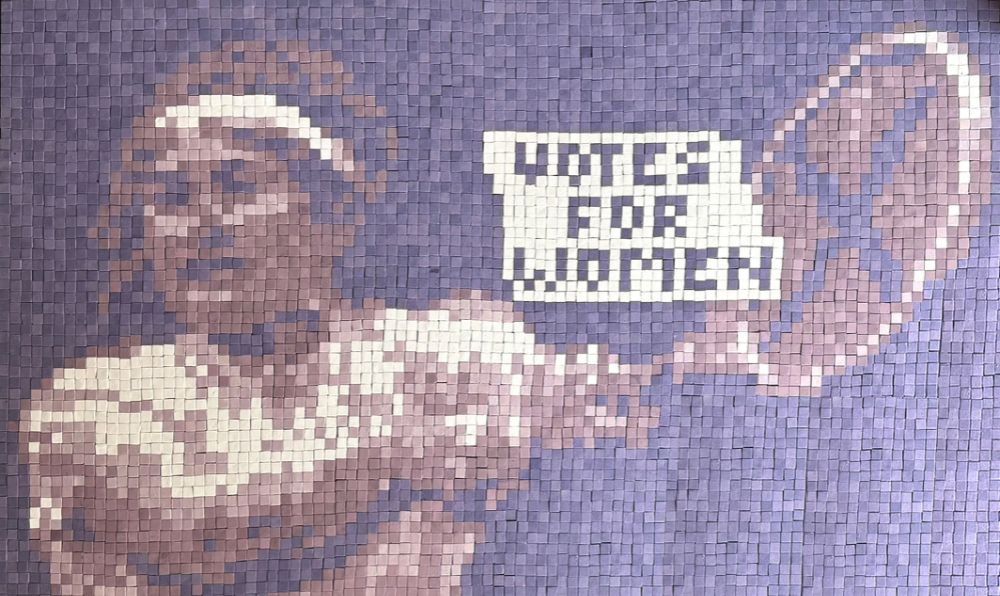
As the world turns its attention to Wimbledon this summer, a new exhibition at Wimbledon Museum reveals a lesser-known story from the borough’s past: its connection to the women’s suffrage movement. Her Court, a collaboration between Young Masters and the museum, brings contemporary art into dialogue with archival material, exploring themes of courage, resistance and public voice. Opening during the Wimbledon Championships, the exhibition features painting, sculpture, ceramics, photography, textiles, and film, with artists responding to historical artefacts connected to the struggle for women’s rights.
For Cynthia Valianti Corbett, founder of Young Masters, the project began with an unexpected discovery. “When we were approached by Wimbledon Museum about a possible collaboration, we were fortunate enough to explore their incredible archival material,” says Cynthia. “To my delight, we discovered fascinating artefacts from the Victorian era, including memorabilia connected to the suffragette Rose Lamartine Yates.” The more Cynthia and her team explored the archives, the more compelling the story became. “We quickly realised there was an extraordinary wealth of material that could inspire Young Masters alumni and emerging artists.
One of the most surprising discoveries was the visual connection between Wimbledon and the suffragette movement itself. “The link between the colours white, purple and green was a revelation,” says Cynthia. “These colours were famously used by the suffragettes in their banners and protests, yet they are also synonymous with the Wimbledon Championships. It seems obvious once you see it, but until we started researching the project, we hadn’t appreciated how closely aligned they were.” That visual overlap forms a central thread throughout Her Court. The exhibition explores not only the symbolism of colour but also broader questions of visibility, representation and public identity. By placing contemporary artworks alongside historical artefacts, the exhibition invites visitors to consider how struggles for equality continue to resonate today.
The project also reflects the mission of Young Masters, the not-for-profit initiative founded by Cynthia in 2009, which has helped launch the careers of more than 400 artists from over 85 countries.
An open call attracted submissions from artists working across a wide range of disciplines. “Artists were eager to engage with this important and ongoing conversation through their work,” says Cynthia. “The breadth of approaches, materials and perspectives was impressive, and the quality of submissions made the final selection process extremely challenging.” Visitors can expect a rich variety of artistic interpretations, each offering a unique perspective on the exhibition’s themes. “We hope people experience a genuine sense of discovery,” she says. “Each artist has responded differently to the idea of Her Court, and together they create something thought-provoking, accessible and deeply engaging.”
(Scroll to keep reading)
Cynthia Valianti Corbett (c) Emma Pratte / Helen Pankhurst
Alongside the exhibition, a special Time & Leisure In Conversation event will bring together Cynthia, her daughter Carmela Corbett, an actor and Women’s Aid Community Ambassador, and women’s rights campaigner Helen Pankhurst CBE, great-granddaughter of Emmeline Pankhurst and granddaughter of Sylvia Pankhurst, two of the most influential figures in the suffrage movement. For Helen, recovering local histories such as Wimbledon’s role in the campaign for votes for women is essential to understanding social change. “Local stories resonate locally and help to tell the national story. What was powerful about the suffrage movement is exactly this, how women up and down the country, of all ages and backgrounds became involved and campaigned together. Without the local stories, history becomes partial, its richness and tapestry are lost.”
Helen believes contemporary art plays a crucial role in reconnecting audiences with that history. “Art was central to the suffrage movement and the suffragettes were brilliant at its use, at understanding the power of art, of imagery, of pomp and ceremony. As Sylvia’s granddaughter, I am particularly aware of how powerful art can be as she was the artist behind a lot of the suffragette designs. Art contributed to the movement then and it can contribute to our understanding and emotional engagement with the movement today.
While the suffragettes achieved one of the most significant democratic victories of the twentieth century, Helen argues that many of the issues they fought against remain unresolved. “If they were here today I have no doubt that they would be urging us on, in all aspects of gender inequality. They saw the vote as the first tool for change, for accessing some power and ensuring that policies reflected their interests. Their motives for engaging were because of their own experience of violence, economic inequality and so on. When you start looking at the detail of women’s lives it is evident that many of the inequalities persist, some having morphed into new forms: the rise of pornography and abuse through social media for example. Emmeline wanted ‘women to count as much as men’. That struggle remains, women are still not considered as important as men. Their voice matters less. The economic activities they are most associated with are either not monetised or poorly monetised.
Progress in political representation also remains incomplete. “Emmeline would be disappointed that over 100 years after some women got the vote we are only at 41% representation in parliament and that this figure is the highest yet. Progress to 50% cannot be taken for granted.
Asked what younger generations can learn from the suffragettes, Helen points to their creativity, determination and collective spirit. “There is so much to learn from the suffragettes around communication and inspiration. Their tactics around militancy define them, but this was a response to their lack of political voice and the tactics of the government which ratcheted up the violence on both sides. Direct action is different from militancy and was always on the cards. Understanding when this is a useful tool and when it is not, what form it should take, and what the consequences of its use are is also particularly important.
“I would argue that they were lateral thinkers and that this is part of their magic. Finally, their campaign was about bringing people together across difference, creating a movement – literally and figuratively. The importance, the power and the joy of working together for a common and progressive cause cannot be over-emphasised.
Helen describes what she has learned from her family’s legacy and what continues to strike her most about Emmeline and Sylvia: “Emmeline’s single mindedness, her dedication, her incredible courage and determination. She and her middle daughter, my grandmother, were very different and I draw inspiration from both of them for slightly contradictory reasons. Emmeline inspired by her force, Sylvia by her gentleness. Emmeline believed that in the time of war they were facing, you follow the leader and she was the leader. Sylvia believed in the importance of everybody’s voice in decision making – particularly when it came to issues around democracy.”
The visual symbolism explored throughout Her Court remains one of the exhibition’s most striking themes. The suffragettes understood the power of colour, imagery and messaging in a way that feels remarkably contemporary. “They were central, three colours with their symbolism and everybody knew what they are about. They also had three words ‘Votes for Women’ and another three words ‘Deeds not Words’. It’s an interesting question about symbolism in political movements today. I feel they are much less important somehow. Maybe with a more illiterate society these were more important. However, the saying that a picture is worth a thousand words is probably still true. The problem is that we are bombarded with a million images and words so it’s that much harder to ensure your images and words are kept centre stage.”
Ultimately, Her Court is not simply an exhibition about history. It is an invitation to reflect on the relationship between past and present, and on the continuing relevance of the questions the suffragettes raised. Asked what she hopes visitors will take away from the exhibition, Helen’s answer is simple: “The connection between past and present.” As Wimbledon celebrates excellence on the tennis court, Her Court offers a timely reminder that another struggle once unfolded here — one fought not for trophies, but for equality, representation and the right to be heard.