Edward Gibbon: The Scribbler from Lime Grove
Edward Gibbon: The Scribbler from Lime Grove
Hugh Thompson, retired Fleet Street journalist and vice president of the Putney Society, considers Edward Gibbon Britain’s first great historian.
Edward Gibbon, famed for The History of the Decline and Fall of the Roman Empire, which was published in six volumes between 1776 and 1789, was a Putney man. As was his grandfather, dad, mum’s family and it’s where he was born. He may always be associated with his magnum opus and Rome, and he may have lived long periods in Lausanne, but it’s Putney’s air he first breathed.
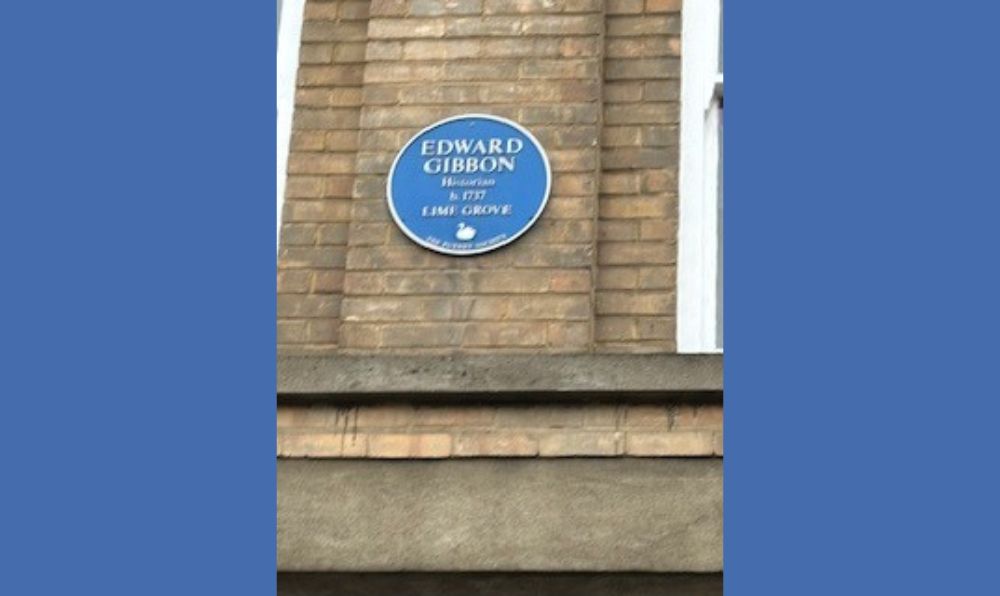
It starts with Lime Grove. Putney, like many of London’s villages before industrialisation, was dotted with grand houses for the great and the good who had to be near the court or the City. Lime Grove was one of its premier residences, set in acres bound by Putney Hill, Upper Richmond Road and Keswick Road. It was owned by the Gibbon family from 1720-37 and finally pulled down in 1870.
Grandfather Gibbon was a self-made man. A draper who clothed the armies of King William and King James, he became a director of the ill-famed South Sea Company: the epicentre of one of the great stock market bubbles, scandals and crashes. Disgraced, fined but by no means beaten, the grandfather, as his type do, bounced back. He was so wealthy that for a private tutor they employed theologian William Law, “the father of Methodism”. When Law retired, he lived happily on Gibbon’s aunt’s generous hand-outs.
Edward was always sickly, and all seven of his siblings died young. His inconsequential father was largely absent and his mother died young – which may explain Gibbon’s personality. A loner, he found refuge in books. After his mother died he was brought up by his Putney aunt. Following his private tuition, he went to Kingston Grammar and then onto Westminster School until the stout little fellow, aged 15, went up to Magdalen College Oxford.
Here two things happened: he left early, considering his two years there as “the most idle and unprofitable in his whole life” and damning his tutors for “being more interested in their salaries than their duties”. But more, he converted to Catholicism. Student rebellion, deep conviction – whatever his reason, it wasn’t acceptable. He was packed off to Lausanne, the seat of Protestantism.
His five years there did two things: got him back into mainstream Protestantism and exposed him to European enlightenment. Reasoning, learning and original sources were now his second nature.
(Scroll to keep reading)
In 1762 he returned to England, now at war with France. He joined the Hampshire militia and in 1764 he set off on his Grand Tour. In Rome, sitting among the ruins of this once Imperial City, was where he had idea for the Decline and Fall. But first, there were less successful literary ventures – then his father died. This guaranteed his income and he inherited a parliamentary seat in Cornwall. With that came a government sinecure and income.
He was a made man. He joined Dr Johnson’s famous club alongside Joshua Reynolds, David Hume and David Garrick. He was a member of Boodles and Whites. He had a town house, a place in Brighton and cottage in Hampton Court.
And so, we come to the book. Thirteen years to write, a million words, and six volumes long. The first history to be considered a work of art. Authors as far apart as Winston Churchill, Evelyn Waugh, Trevor Roper and Lytton Strachey consider it England’s finest, for its scholarship, its style and its language. To get its tone right, Gibbon wrote the first chapter three times and the second and third twice. There are 8000 footnotes – many in Latin and Greek, which the enlightened Gibbon assumed his readers knew.
In today’s money, it cost £800 but that didn’t stop it being a sell-out. However, it was not without controversy – not least in why Rome turned to Christianity. The conventional wisdom was that this was God-given; it was decreed by God and so it happened. Gibbon looked under the bonnet and found rational reasons why Rome chose Christianity and thereby turned it into a world religion.
For many he is the British Voltaire: a supreme example of a rational, educated and highly intelligent mind. He said, “History is indeed little more than a register of the crimes, follies and misfortune of mankind.”
Of the perpetual warfare which clouded his and other generations, he wrote, “As long as mankind shall bestow more liberal applause on their destroyers than their benefactors the thirst for military glory will ever be the vice of the most exalted characters.” It was never his vice.
He never married. He was a small, stout and extremely vain man; pompous and a snob. He was accused of dressing like a peacock. “His apparel a little overcharged, if his person be considered.” His shortness of stature, his corpulence, and his waistcoats, cane and sword made him more than slightly ridiculous. Many enjoyed his conversation but he was close to few.
Upon losing his parliamentary seat and the government sinecure, he retired back in 1780 to cheaper Lausanne. It was there he spent most of his last ten years dying of the embarrassing ailment he suffered throughout his life, fluid on the testicle. It didn’t make tight breeches any more attractive.
But against all this, Edward Gibbon was famous for his deep and loyal friendships. If he was not a passionate man, he was indeed an affectionate one. A brilliant intellectual ahead of his time, he found his purpose, his great work which 250 years later is still applauded. So he was pompous, he was vain, he was a snob. But he lived a happy, pampered and if you will, privileged life on his own terms. Overall as Lytton Strachey says in his essay, “At every stage of his life Gibbon is a pleasant thing to contemplate.”