Clown eggs
Eggs-traordinary faces
The art of clown eggs and preserving clowns’ identities
By Caroline McConnico
Inside Julie Proctor’s gallery in Merton Abbey Mills, you can peak in to the fascinating world of clown eggs.
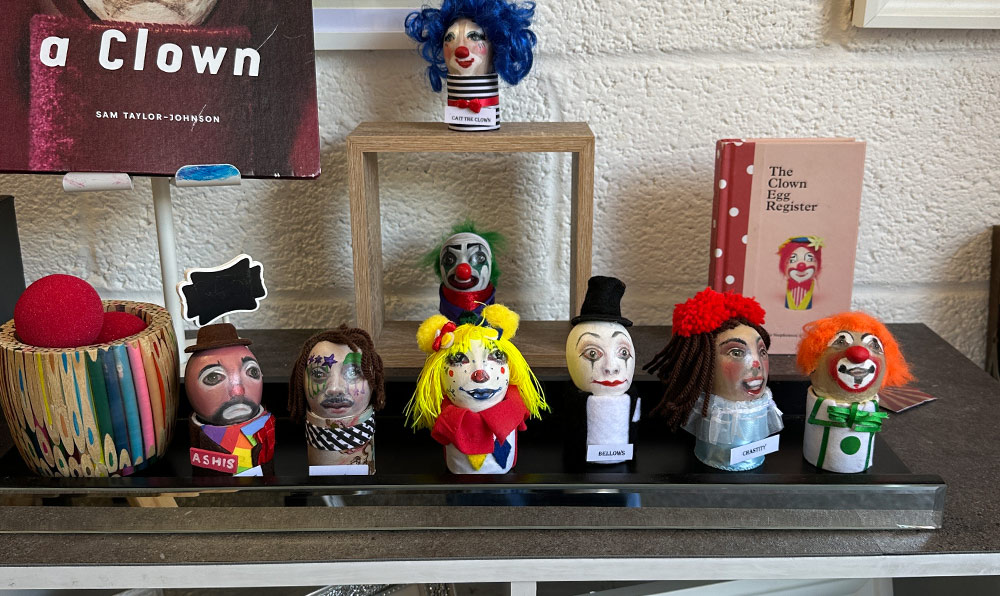
Julie is the official clown egg artist for Clowns International, the oldest organisation for clowns in the UK. She spends her time capturing clowns’ faces on these hard-shelled objects, some of which take weeks to complete. This is part of a very old tradition in the clown community, where a clown’s makeup is preserved on an egg so that their look can never be copied by others.
“For nearly 100 years, clowns’ makeup and costumes have been registered on an egg,” says Julie. Stan Bult, the founder of Clowns International, started this tradition in the 1940s. His collection of eggs quickly grew into what is now the Clown Egg Registry, a couple of hundred eggs all housed inside the Clowns’ Gallery-Museum in Dalston.
The clowns used to be painted on real chicken eggs, but now are captured on ceramic ones so they do not break as easily. Many people have written books about the clown eggs, including British filmmaker Sam Taylor-Johnson, who created a coffee table book documenting all of the clown eggs ever created.
(Scroll to keep reading)
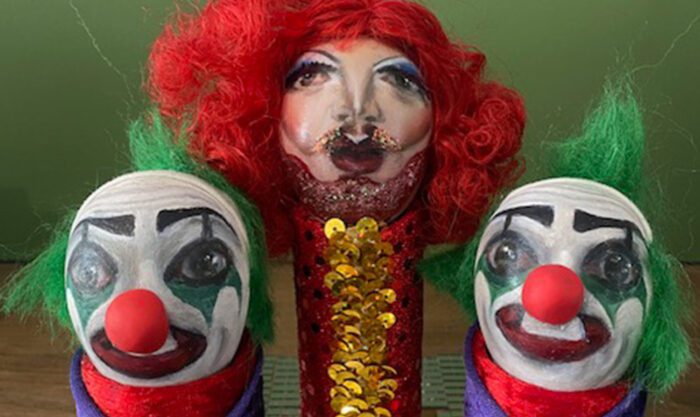
In order to be registered on an egg, a clown must become a Clowns International member and pay a fee. Other egg qualifications are that the clown must be a happy clown and performer, not just someone who dresses up and scares people. If a clown meets those requirements, Clowns International will send photos and bits of the clown’s costume to Julie for painting inspo. Julie will then create two eggs, one for the clown to keep and the other to be housed in the museum.
Julie told me there can only be one clown egg artist at a time, and she is the fifth registered artist. Her journey to clown egg artist is a little more scrambled than you might think.
“I learned to paint during lockdown, and I was a face painter before that,” Julie says. “I started doing oil portraits of people with face paints on, and I quite liked the clown face. I Googled to get some inspiration and these eggs popped up. I fell in love with the concept.”
Julie says she wanted to paint the clown eggs onto canvases and reached out to Clowns International for permission. The organisation’s committee responded a few months later, granting approval and asking her if she could be the next clown egg artist.
“I was honoured,” Julie says. “So I had these different eggs, and sent them off to Canada. The committee came back and said, ‘yes, (the position’s) yours.’ And that was two years ago.”
Compared to painting on canvas, Julie says eggs are a much harder medium. Although the eggs are oval, they are not the exact shape of a face, so there is still much work to be done to make the faces three dimensional and life-like.
The attention to detail of the egg painting is crucial. For example, she says it is “clown law” that if the clown paints on their red nose, then Julie must paint the red nose on their egg, but if the clown has a fake red nose, Julie must build a tiny red nose for the egg.
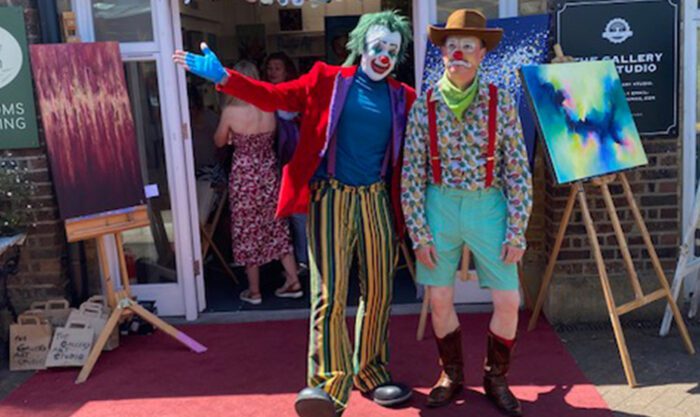
On 29 June, ‘Blotto’ the clown was presented with his egg at Julie’s gallery, Proctor Art, in Merton Abbey Mills. Blotto is the character of multi-Emmy nominated makeup artist Brian Kinney, who first appeared on London’s streets in 2000. “(Blotto) came and we had a big show,” Julie says. “He brought two other clowns with him, and they were just amazing.”
Julie is planning to create a Drag Queen egg museum to display the eggs she paints of drag queens around London. She has just completed her first egg and has been working on creating a registry. The museum is planned to launch on 30 August.