Interview: India Amarteifio
Interview: India Amarteifio
The actor on Kingston International Film Festival, life after Queen Charlotte, and why she’s drawn to independent film
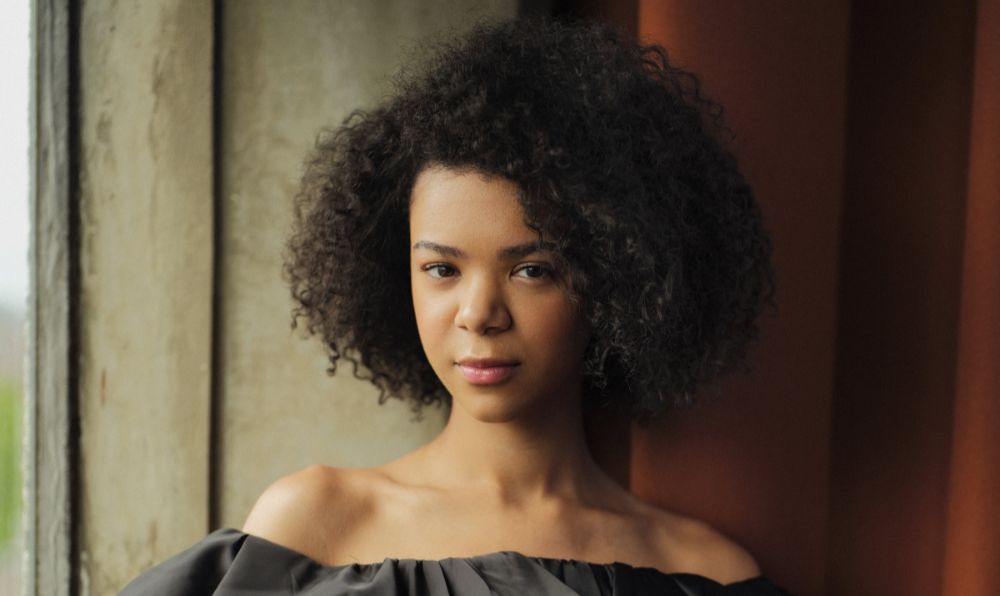
For India Amarteifio, supporting the Kingston International Film Festival (KIFF) is as much about community as it is about cinema. Born in Kingston and raised in nearby Twickenham, she has remained closely connected to the area and its creative scene, and was delighted to be asked to serve as a KIFF ambassador over the past few years. “I’ve lived here my whole life, so I’m really happy to support a newer film festival in the place I grew up in, which has been filled with a lot of creative people.”
Now celebrating its fifth anniversary, the festival features screenings, workshops, and events for both industry and the public, including this year, an ‘Audience with Mike Leigh’ and the world premiere of US Comedy 25 Miles to Normal starring Rachel Nichols (Continuum); Bruce Davison (X-Men); Ed Begley Jnr (Arrested Development), and Michelle Hurd (Star Trek: Picard). Alongside its three-day programme, KIFF supports creativity in the borough year-round.
For India, its value lies in restoring cinema as a shared experience. “There’s this feeling that going out and watching films together might be fading a bit,” she says. “So what better way to bring that back than starting closer to home? It’s a chance to give people access to film and encourage them to experience it as an audience.”
She also has a strong passion for independent film, describing her work with American indie studio Neon as a career highlight. The project, Clarissa, is a modern reimagining of Virginia Woolf’s Mrs Dalloway, starring Sophie Okonedo. “We filmed in Nigeria in late December. Honestly, it was my dream job – working in film, which I’ve never done before, on the continent where half of my heritage is from, with amazing actors. It was such an unreal experience. Making an arthouse film has always been a dream and feels like a direction I’d like to go in.”
(Scroll to keep reading)
India began her career on stage, making her West End debut as young Nala in The Lion King, followed by roles in Matilda the Musical and Charlie and the Chocolate Factory. Television work in Line of Duty and The Interceptor followed, before her breakthrough in Queen Charlotte: A Bridgerton Story.
Stepping into the Shondaland world marked a major shift. “I had just turned 20, and to be given the opportunity to lead a show for Netflix and Shondaland – I’m quite glad the enormity of it hadn’t really set in while we were filming, because I think it would have really shaken me. But I just had the most incredible time. I’ve made some amazing friends who I still keep in contact with.”
The role’s impact extended beyond her personally. “Seeing brown people, especially brown girls, portrayed in such a regal and elegant way has altered a lot of people’s perception of themselves,” she says. “It also shaped me to be a lot more confident and comfortable in my skin as a woman now.”
That experience also reshaped her understanding of screen storytelling. “As actors, we’re not doing a job that saves lives. But there are projects where people go away having learned something or felt something.”
Despite her visibility, she resists the idea of being a role model. “If I’m being authentic to myself and that resonates with someone, that’s all I can do. I’m lucky to have a platform as a by-product of my job, so if I can encourage someone to think about giving to a charity or something I do has a positive influence, that’s enough. I would never expect anyone to look up to me. That creates pressure, and an image that may not be real. Like everyone, I’m imperfect.”
Instead, she points to her mother as her biggest influence: “Her resilience, her hard work – a single mother raising two daughters on not much money, putting our needs above hers, and running a business by herself.” Her mother also provides a grounding perspective. “She’s always someone I can go to. She’s very rational.”
India describes her upbringing as peaceful. “I was near to the river, close to the Royal Parks. There was also the freedom to go into London when I needed to, then come back to a real community feel.” But there were moments of disconnection. With Ghanaian British heritage, she sometimes felt out of place. “When I was younger, the area wasn’t as multicultural as it is now, so being of mixed heritage, I felt a bit different to other kids.”
Her early training was rooted locally at the Richmond Academy of Dance. “I wasn’t able to afford many extracurricular activities, and the principal, Miss Harita, offered classes at a discounted rate because she saw I was willing to put in the time and effort. She gave me a lot of her free time. I’m very grateful and hope one day I can give something back.”
She also credits Darrall Macqueen, an independent children’s television production company, for early support. “They really supported me throughout my education at drama school. I won’t forget their belief in me.” She later trained at the Sylvia Young Theatre School, where she formed lasting friendships. “You’re growing up with these people and doing what you love. They become your life.” Among them are Stella Quaresma of FLO, also born in Kingston, and Georgie Farmer, known for Wednesday, whom she worked with on Disney’s The Evermore Chronicles. “It’s lovely to see people you’ve come up with doing so well. It makes my heart very warm.”
Outside work, she describes herself as “a bit of a granny.” “I’m naturally quite routine-based, and I have to let that go in the workplace. So when I can, I stick to very mundane activities to feel some level of normality.” That includes gardening, reading, running, tennis, and long walks. “Maybe yomping around somewhere in Surrey. It’s calm, peaceful, and it’s home.”
Her schedule is now packed. She is heading to Cannes for the premiere of Clarissa and will also appear in The Rapture, a BBC drama starring Ruth Madeley. “It’s the first thing I’ve filmed properly since Queen Charlotte. It was one of the biggest challenges I’ve had, in terms of characterisation and how far it was from myself. Coming out of it, I feel like I could do anything.” The intensity of filming stayed with her. “Every day you’re dealing with quite gory details and heavy material. After a while it takes a toll. You need ways to switch off.”
Looking ahead, she is drawn to smaller-scale independent filmmaking. “The funding isn’t always there for films without big spectacle. But I really enjoy character-driven stories. That’s what I like watching and what I like making.”
She also hopes to return to theatre. “Theatre is where it started for me. It’s grounding. It’s important to keep watching it, but also to keep doing it to hone your craft. I’ve never done theatre as an adult, so that would be exciting.”
For now, she is focused on the upcoming releases of The Rapture and Clarissa. “It’s been three years since Queen Charlotte. I feel like a very different actor, so I’m excited to show what I’m working on and how my acting has changed and matured. I hope people will enjoy that.”
Image: Phil Sharp