


Framed to Perfection: Creating a Gallery Wall That Tells Your Story
Framed to Perfection: Creating a Gallery Wall That Tells Your Story
A gallery wall can tell a million stories. Unlike a single statement piece, it can beautifully frame your life – a collection of memories, moments and moods that tell the story of who you are. When it’s done well, it looks effortless. But capturing that perfect curated look is trickier than you might think. Too planned and uniform and it can look contrived and sterile. But too random, it can easily tip into chaos and tell no story at all. The art of creating a gallery wall lies in editing, arranging, and framing to match your intent.
Whatever imagery you are working with – family photos, travel prints, or abstract art, the secret is to achieve balance and harmony without losing your unique story and personality. If you’re looking to design a gallery wall that feels distinctly yours, here’s the lowdown.
Begin with Your Theme
Before you get your hammers, hooks and nails out, sit back and think about what story you want to tell. There is no right or wrong theme, whatever you go for, a gallery wall works best when the pieces are connected by an underlying concept. It could be the places you’ve seen, a colour, a mood, or simply the evolution of you and your loved ones over the years.
Try not to overthink it – lay everything on the floor in front of you and see what tickles your fancy! Experiment with combinations. Although it may sound counterintuitive, a child’s drawing next to a slick, minimalist print, or a moody black and white photo beside a soft watercolour can be gorgeous in the right thematic environment.
Planning your Layout
More prep at this stage – if you’ve got an impulse to go in with nails and good intentions, shout STOP! This is not a time for winging it. Make paper cut-outs of your frames and then tape them up on your selected space. This will allow you to evaluate spacing and composition without leaving your wall looking like Swiss cheese and requiring the services of a plasterer.
Start with your favourite piece. You don’t have to have it smack bang in the centre of your gallery wall, but you should think of it as an anchor to build your arrangement around. Then, commence building outwards, mixing sizes and orientations to the eye can scan around the wall naturally. Gaps should be consistent (2-3 inches can work well). Step back at every stage and see how your arrangement works visually. When it feels good, you’ll have balance!
Mix, Match – but Keep It Harmonious
The best gallery walls blend variety with visual balance. If things are becoming chaotic, then take a step back and rebuild from the stage where you felt happy with the layout. And don’t just consider the images themselves but think about the frames as well – very much part of any piece. Play with different colours and finishes. Combining different frame colours (for instance, oak next to black or brass adds depth) can work beautifully, while sticking with one tone and finish across your pieces can add a sense of cohesion to a sleek and modern look.
If your wall includes artwork of varied sizes, use larger frames as anchors and cluster smaller ones around them. The BGA Store’s frames 50×70 are a great size for this purpose — large enough to make an impact, but still easy to blend into a mixed arrangement. Their clean design makes them versatile for both modern and classic interiors, and work in both portrait and landscape orientations.
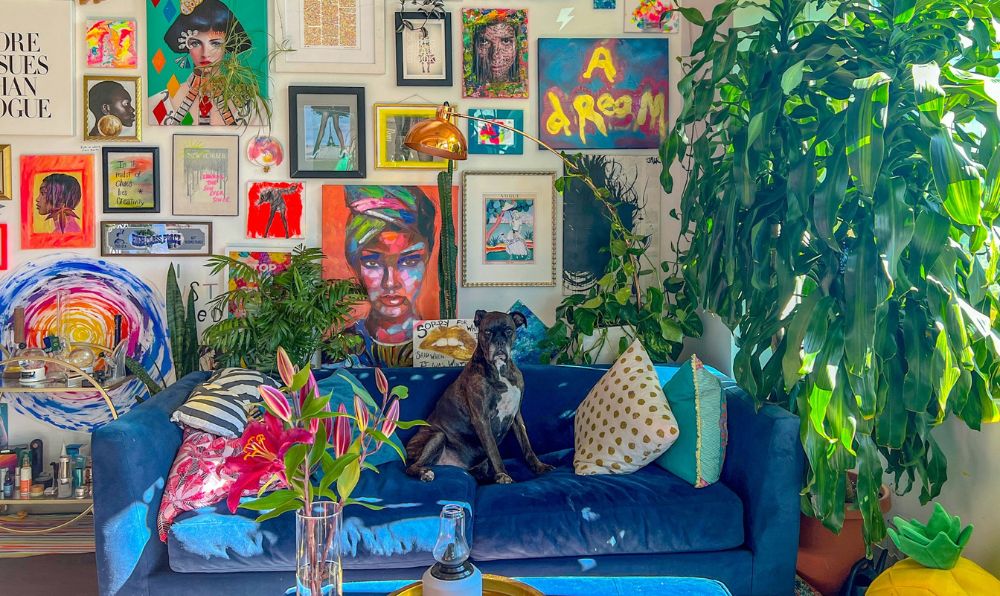
When you’ve found your frame combination, think about the overall shape your collection forms. Gridded layouts feel neat and architectural, while looser, salon-style arrangements have a more eclectic charm. There’s no wrong approach — just one that fits your space, style, and personality.
Think About Contrast and Texture
Flat walls (unless painted in particularly striking colours) are pretty boring. But get an arrangement with texture and contrast working, and your gallery wall will sing. Mix media – glossy photos near matte paper prints, watercolours near line sketches or landscapes next to typography. Frames are fantastic for adding texture. Think warm woods, soft brasses or matte black frames packing a heavy graphic punch. Using a consistent mount size can help tie everything together. And don’t forget to get the lighting right to evoke a mood – natural light is wonderful for vibrancy and change throughout the day, while a well-placed picture light, or a pair of adjustable spotlights, can turn even an average looking gallery wall into a showstopper at night.
Final Touches
Remember, your gallery wall should never be truly finished. As time goes by for you, your display can evolve with you. Keep it fluid and swap in new images, or introduce art picked up on your travels. Your wall will grow with you!
The true magic of a gallery wall isn’t its symmetry or polish — it’s the emotion it carries. It’s the holiday photo that still makes you smile, the sketch your child drew, or the vintage print that’s followed you from home to home. When you hang those pieces together, they become more than decoration; they become part of your daily life.
So, take your time, enjoy the process, and don’t aim for perfection.